Interview with artist, Rafael Francisco Salas

This month we had art professor and artist, Rafael Francisco Salas visit North High to share his art, influences, and process with our students. 

Rafael Francisco Salas, Untitled Portrait (Houses), oil on canvas, 22 x 42 inches, 2010

Rafael Francisco Salas, Untitled Portrait (Houses), oil on canvas, 22 x 42 inches, 2010

North High Art Department: What/who is your biggest inspiration?

Rafael Francisco Salas: I mentioned a few influential artists – Isa Genzken, Cy Twombly,  and Byzantine artwork

In addition, old country music as it relates the landscape, and then of course the landscape of rural Wisconsin itself.

NHAD: What is your favorite medium to work with?

RFS: Oil paint and charcoal

NHAD: When did you start painting?

RFS: I always was interested in making art, but didn’t begin oil painting until I was about 23 years old.

NHAD: At what age did you start being an artist?

RFS: Pretty much my whole life.

NHAD: Why did you choose to do abstract painting?

RFS: Great question. Abstract art (to me) is able to communicate beyond language. If a painting has a human figure, a viewer responds with the knowledge that the painting has a person in it. But abstraction requires a different reading, that is more personal and emotional. It comes from the gut.

NHAD: How long does it take to finish a painting?

RFS: Sometimes they move along quite quickly, like two or three weeks. Other times a couple of months.

NHAD: Do you enjoy changing your media & materials?

RFS: It’s exciting and very challenging to work with new materials. Sometimes it’s a disaster!

NHAD: Is all of your work based on your experiences?

RFS: Yes, most of it is pretty autobiographical. It’s what I know.

NHAD: What made you want to go into art/study art?

RFS: I always enjoyed it and was inspired to make art. Plus I was never good at anything else!

Artist Statement: 

My current artistic project begins by describing the landscape and its moods that I have observed in Wisconsin.  They include natural occurrences as well as man-made events and architecture which complement and conflict. Our creations and habits rub up against what is native or wild. Those interactions describe our new selves.

The use of non-representational and still life elements in my artwork creates a dichotomy between figure and ground, between the perceived and the felt. Like the nature of the landscapes I observe, the artwork aspires toward a certain nobility, but often illuminates a poignant contrast to that aspiration.

Country music is the appropriate soundtrack.

About The Artist Lecture Series

The Artist Lecture Series is an in-school program at Sheboygan North High School that invites local and regional visual artists to share their journey as artists with the beginning, intermediate, and advanced art classes. Visiting artists present and expose art students to such as but not limited to: a digital portfolio, actual artworks, talk about about careers, and the opportunity to interact with the artists. This program is organized by the Sheboygan North High Art Department. 

How Does Art Unite Us

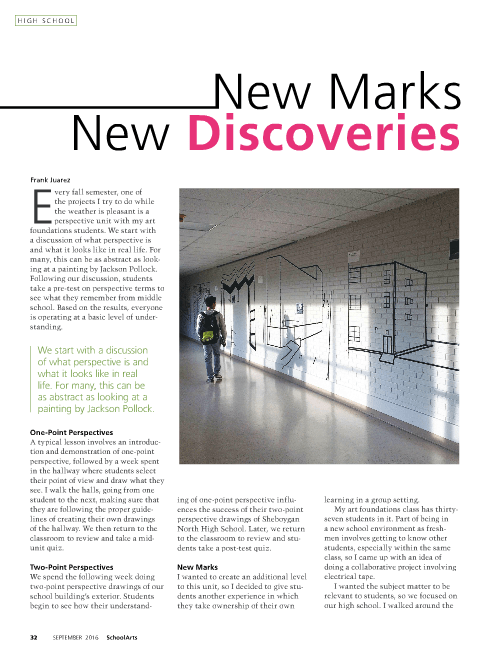
Drawing Intensive students were given the task of creating an 18″x24″ art advocacy poster addressing, “How does art unite us”. Students chose their own medium/a to turn their idea into reality. Each poster shares how they view art and their lives. 

The above prompt was issued by SchoolArts Magazine as part of an annual art advocacy poster design challenge. 

img_2163

Sheboygan North High IMC

Artist Spotlight: Megan Woodard Johnson, mixed media

newnhslogo_copyOn November 15, mixed-media artist, Megan Woodard Johnson visited period 7 Drawing Intensive artists. She talked about her work, her process, ideas, and inspiration. During her presentation they came up with a list of questions. Due to length of time allocated these questions were emailed to Megan for her responses. 

Art Student: How long do you usually take to get your artwork done?

Megan Johnson: I can usually finish a piece in 4-5 days. There is a lot of waiting in my process- for glue to dry, for paint to dry between layers, etc. But once I’m rolling, the image tends to evolve really quickly.

I also frame all of my own work- which can take as many days as the painting itself. I save a lot of money this way, and have control over the details- but it’s time consuming.

AS: How do you sell work? Where do you find buyers?

MJ: The first thing to know is that I sell work by being patient and persistent: I start by having it out in as many different venues as possible: group juried exhibitions and art fairs; art guilds and art center events; art-making demos, open studio tours, and giving workshops. People do not always buy work right away- but they become engaged with me and stay connected via email updates or following me on social media. If they like my work enough to follow me, eventually there is a piece they like enough to buy.

I currently have work in the two John Kohler Arts Center gallery shops and a gallery in Cedarburg. Both opportunities came about because the owner/buyer had seen my work in other venues, and I had struck up a friendly relationship with them, so was easy to find when they had space for new work.

I participate in a few summer art fairs- and have had to do a lot of research to find fairs in places where I think the customers will be interested in actually buying my work. So far for me, that means people in more urban areas, with an appreciation for art and the income for purchasing art for their homes. (For me, large, well advertised shows in Chicago have been great – but I didn’t figure that out until I suffered through some very quiet, local, non-juried art and craft fairs).

I post new work routinely on Instagram and Facebook, and keep my website up to date with work and prices, so have made a few sales through those channels (followers DM me or email me and we take it from there).

AS: Where do you get your inspiration from?

MJ: I find a lot of great art on instagram and even pinterest that inspire my color palettes and sometimes my mark-making and technique.

As for my content, I’m inspired by how intricately humans are linked together, across the globe and across time. I’m also inspired by the things that humans make for practical use- especially old things that show the impact of time.

img_9904

AS: Any doubts about your current career?

MJ: No. But that wasn’t true until 2 years ago- and I’ve been at this a long time: I graduated from college 20 years ago.

When I decided to stop doubting my work, I stopped doubting whether I was really deserving of the title ‘artist’. When I stopped doubting that, I stopped doubting whether I should put my work out into the world more, and take more chances with shows etc. When I stopped doubting that, my work began to find its audience.

AS: What is your favorite medium to work with?

MJ: There is no one favorite medium for me, and there is no working in one single medium for me- I love them all, but need to work with them all together to say what I want to say. I have found that I do not connect with photography or digital arts as a maker- I need messy hands and direct contact with my art. (But as an art appreciator and consumer- I love them!)

AS: Are you always proud of your work?

MJ: No way!!! I have made some ugly, awkward, awful and totally un-successful pieces – LOTS of them! I don’t resent them- but I also don’t frame them up and show or try to sell them.

AS: Do you feel that there are colors that you gravitate towards?

MJ: There does seem to be a pallette I pull toward- colors that have a faded, warmed-up quality. I love color in general, and have a very strong foundational knowledge of color theory. (Study color theory very seriously- I really believe it’s the underlying subtle element that will make your art work or not work.)

img_2148

AS: You already found your ‘art style’. Do you ever think about starting or trying to find a completely new style?

MJ: I’m 42 years old, and have been making art seriously in one way or another for 25 years. I have a style that in some ways has always been a part of how I make art. Look at college and High School work of mine you will see a combination of clean, almost architectural style drawing with very loose, gestural painting and scribbling. It’s a yin and yang for me- both qualities feel equally important in all parts of my life.

The series of work I’m currently working on- with the layers of collage, the house-shapes, etc. is what is happening naturally in my studio- but I know it will change and evolve. My approach in my own art is to follow a path or a series until it no longer feels comfortable. When I’m restless with what I’m currently doing, I know it’s time to let something new develop.

AS: Do you get nervous to present in front of classes?

MJ: Yes. For sure. I’m very happy talking one-on-one about my work, but a room full of people is a little daunting! You guys were a great audience 🙂

AS: What techniques do you use when making your art?

MJ: Basically, I start by gluing small pieces of vintage paper all over the paper to create a textural background. I slea that with clear acrylic matte medium, and then start painting. I paint with acrylics, then sometimes remove that paint with rubbing alcohol to get a washy effect. I’ll coat over the whole piece with matte medium several times throughout the piece- sealing down layers, and allowing me to then add different mediums on top of the paint: graphite, pastel, oil pastel, colored pencil, gold leaf. I’ll glue down more collage elements to help create the lines of the houses.

AS: What is the best part about sharing what you love?

MJ: I always love chatting with people about what they find interesting. When they find something that I’ve painted interesting, and want to know more about it- or tell me what they’re drawn to, it’s incredibly validating and heart-warming.

AS: How do you price your artwork?

MJ: I have a basic awareness of my material expenses, so I want to cover those for sure. And I want to be realistic not only about the hours that it takes me to finish one painting- but the years of experiences and training I have in this field, so I try to value my work in a way that respects that.

I look to work done that feels similar to mine in size, medium and the audience it might appeal to, to get a feel for how pricing is going in the world right now. I’ve also had good feedback from the galleries I’m with- in terms of letting me know if they think my prices are appropriate. And now, with 2 years of solid sales in this current series, I feel confident that my pricing is solid.

I very much want my work to be priced in a way that allows it to be attainable to buyers, but attainable does not mean cheap. Buyers in my target audience will spend $100 on a massage, a dinner out, a nice pair of shoes or a concert ticket and not bat an eye. Art for your home is something you purchase because it moves you, and it will be in your home for a lot longer than an hour or an evening or a fashion season, so I’ve tried to keep that in mind as I’ve priced my work.

About Megan 

img_2145Early in her art career, she fell in love with printmaking because she was enchanted by the way an image would evolve and build with each new layer of ink. Gradually work, family life, and relocations made access to printmaking equipment more difficult. Experimenting with new materials, she discovered that physically layering actual papers and bits of collected ephemera into paintings and drawings allowed me to make images with a depth that she had never reached with standard printmaking.

Her mixed media approach illustrates how a variety of moments define a total experience. The materials she uses carry the stories of learning, recording, and processing: vintage school books, ledgers, hand- written correspondence. The materials themselves each have a life and history, which is then woven into the stories she tells by adding expressive layers of paint and drawing media.

img_9855

The notion of the meeting place between private moments and shared or universal experiences is her constant inspiration. She loves watching the wide range of personal responses as viewers uncover layers in her work, recognizing book pages or documents from their youth, or finding memories pulled to the surface by familiar patterns and colors. These very personal connections for each individual actually turn out to be common shared experiences, as viewer after viewer recalls similar memories and responses.

Megan’s recent work examines the notion of creating private spaces: places, both literal and imagined, that provide a sense of refuge. She is interested in how the creation of a personal space must be unique to each individual, while at the same time the experience of having or claiming these spaces is almost completely universal.


About the Artist Lecture Series

The Artist Lecture Series is an in-school program at Sheboygan North High School that invites local and regional visual artists to share their journey as artists with the beginning, intermediate, and advanced art classes. Visiting artists present and expose art students to such as but not limited to: a digital portfolio, actual artworks, talk about about careers, and the opportunity to interact with the artists. This program is organized by the Sheboygan North High Art Department. 


Muralin’ with Summer School Art Kids

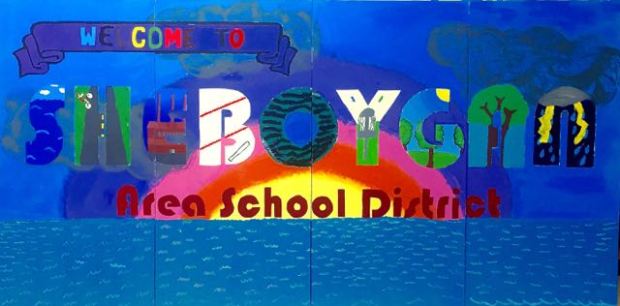
This week a group of middle/high school art students will be creating a 4 foot by 8 foot painting welcoming visitors to the Sheboygan Area School District. This mural will be installed on the 3rd floor stairwell inside the administration building, 803 Virginia Avenue in Sheboygan. 

IMG_8038

Finished Mural

Here are images of their creative process. This process involved designing, selecting, finalizing, and painting their contributions to to the mural. Also, part of the process was to edit the painting to reach the desired result of this collaborative project. Students worked independently as well as in pairs and/or groups. 

A Qualitative Research Study of Arts Education and its’ Impact on Post-Secondary Success. Written by Jenny Sturchio.

This past school year I had the opportunity to work with Jenny Sturchio. She is a grad student at Wisconsin Lutheran College in Milwaukee. Her ideas for her Capstone Final was to research how secondary art education impacts post-secondary success. The Sheboygan North High Art Department was one of her subjects for this research. I found it interesting to read her perspective on secondary art education and her correlations to post-secondary education. It is always neat to read what others think about the arts programming, activities, and relationships that exist within a public high school art program.

Feel free to download this PDF. Courtesy of Jenny Sturchio. 

Here are some excerpts from her research. 

“I find we are presented with material in a very linear way and are expected to understand it in that way as well. By participating in the arts, it has given me the chance to explore ideas and come to the conclusions in a more fluid manner. Having space to work through things abstractly has been beneficial for someone with a right brain way of thinking” (Answer from survey participant, 2016.)

“By being involved in the arts, I was able to find my passion. Being exposed to and given the chance to dabble in artistic curriculum, it opened up doors that would not have been possible otherwise. In a society where math and science are deemed the only suitably successful careers, including arts is a more holistic approach at education. Art has given me more ways to problem solve, and overall another perspective to walk through the world with. I think it is important to keep the arts in secondary education because that is how we keep it in post-secondary, which is important in creating innovators of the world” (Answer from survey participant, 2016.)

“When dealing with a struggling student they refer to creative teaching techniques to create a platform for the student to find success”.

“Not only do they [teachers] consult with the art department for their own classroom integration, but it is observed that arts-active students are more deeply engaged in classroom activities than those who are not”.

“My recommendation would be for high schools to provide professional development for their teachers that covers arts-integrated education”. – Jenny Sturchio

About

J.Sturchio. A Qualitative Research Study of Arts Education and its’ Impact on Post-Secondary Success: This narrative research project was completed in partial fulfillment of the requirements for a Master of Arts in Education degree for the College of Adult and Graduate Studies at Wisconsin Lutheran College, Milwaukee, WI. 50pps.

Feel free to download this PDF. Courtesy of Jenny Sturchio. 

AP Studio Art Portfolios 2016

This school year, 2015-2016, two NHS art students worked on their AP Studio Art portfolios. Both students communicated their intent through varied media such as collage, markers, paint, and artistic vision. These works are on display in the Lower Level from May 18 – June 1, 2016. 

The students arrive in AP Studio Art with a solid foundation in the arts and with breadth pieces of art completed from which to choose. Since AP students have had substantial experience in direct formal art making instruction, the AP class instruction is structured more like a college-level, independent study course where the student and instructor confer to identify an area of concentration for further development based on the student’s strengths, skills, and interests, for example, portraiture, landscapes, abstractions, illustration, and so forth.

Ashley

I am a senior at North High School. I am currently in AP Studio Art and my studio works consists of photographs I captured in the past few years that have a special meaning to me. My artwork tends to focus on nature, and with each body of work, I strive to communicate a variety of emotions to put together a unique portfolio. I used a method called Zentangle to focus specifically on the movement in each piece. I emphasized this element through the use of vibrant lines and the use of value and contrast. Through the different shades and textures, I wanted to tell a different story of my life through the emotions each piece portrayed. Each artwork is a building block that represents a part of my life and what makes me unique as a person.  


Mikayla

The inspiration for most of the pieces comes from fairytales. My intention was to take a happy fairytale and distort it in a way that gives it a different or darker meaning.  The overall feeling of each piece leaves the viewer to feel uneasy and a sense of mystery and also a desire to figure out what each piece means. These pieces all hold a story behind them, creating an even deeper meaning.  I experimented with acrylics and collage and even a combination of the two. I feel as though collage creates a deeper contrast and help the viewer form a more solid idea of the work. I also included one piece that does not fit the fairytale theme, “Even The Mountains Have a Song,” for fun and to display that in the midst of creating one theme, random pieces art can create themselves without any intention of them being there.

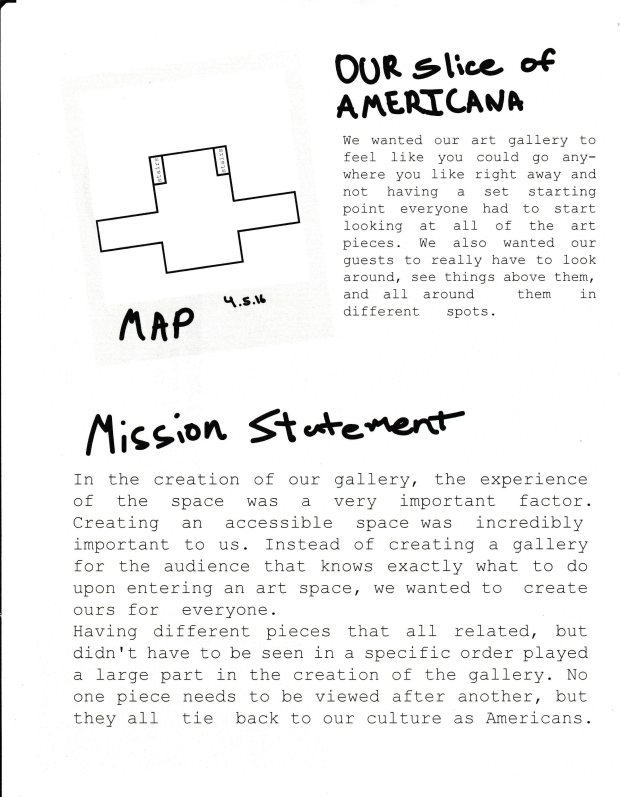
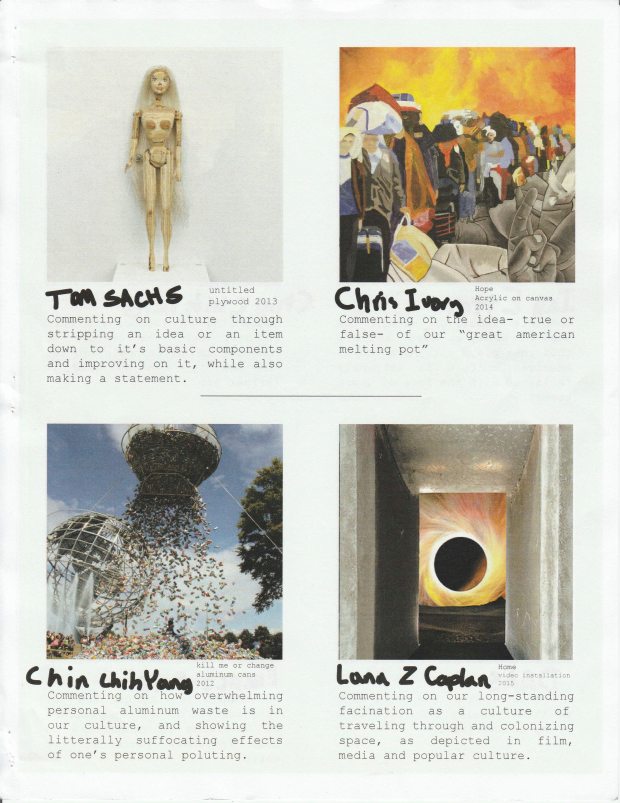
Design it Yourself Gallery Project: A deeper look into the 365 Artists 365 Days Project

Appleton art teacher, Elyse Lucas collaborated with Kate Mothes of Young Space inspires high school art students to research, collaborate, and design their own gallery. Mr. Juarez’s 365 Artists 365 Days Project provided students with a list of artists whose works were explored for the curation of the exhibitions that were organized within their own galleries. 

It is such a rewarding experience to see this project inspire students to look at the [art] world through a different lens. When this project was released on January 1, 2014 the primary intent was to introduce our readership to contemporary artists, studio cultures, and diversity in media from across the globe. It is neat to see this project implemented within a secondary art curriculum and to see the possibilities unfold. – Mr. Juarez, art educator and founder of 365 Artists 365 Days Project.

________________________________________________________________________________

Ms. Elyse Lucas’s unit: Design it Yourself Gallery Project

Unit and images courtesy of the teacher and used with permission. 

Objective: Design your own art exhibition in your own imaginary gallery. The artwork and gallery space must work together to invoke a common theme. Students may select any contemporary art pieces from the list of contemporary artists on Frank Juarez “365 Artists in 365 days” website. Students may design any space that the artwork will be hung. Student will create 3D models of their gallery space as well as an exhibition guide showcasing their selected artwork and describing their theme. Student will then present their ideas to professional curator Kate Mothes. Student will gain a greater understanding of contemporary art, art appreciation, art criticism, and the value to art in a community.

Requirements:

Research on Artwork

  • Select 8-12 pieces of contemporary art from Frank Juarez’s website “365 Artists in 365 Days”
  • Artwork must have common theme (aesthetically or message)
  • Describe artist’s intent with artwork (chart)

3D Model of Gallery

  • Must be made out of cardboard
  • Must be 3D and painted white
  • Must be laid out with where artwork goes and why

Exhibition guide for show

  • Must include mission statement about the show (intent or what message you want the viewer to observe)
  • Paragraph about each artist and description of their artwork

Presentation

  • About 20 minutes long
  • Re-state mission statement and intent with the show
  • Explain why you designed the space in a certain shape
  • Explain why you hung artwork in certain spots
  • Explain what you learned through this process

Standards:

  • Art Theory: Visual Thinking : Vocabulary Use (id:9968)
  • Art Theory: Visual Thinking : Interpretation/Evaluation (id:9969)
  • Art Theory: Visual Thinking : Formulates Opinion (id:9971)
  • Art Theory: Visual Thinking : Personal Opinion (id:9974)
  • Communication Arts 9. : Key Ideas and Details 2 (id:10151)
  • Communication Arts 9. : Production and Distribution of Writing 2 (id:10167)
  • Communication Arts 9. : Presentation of Knowledge and Ideas 3 (id:10177)

________________________________________________________________________________

Design it yourself Art Gallery: Research

Directions: Visit Frank Juarez’s website “365artists365days.com.” Click on the “Artist Database” link at the top and then “Download 2014/5 Artist Database” link. You can choose to look up an artist based on their medium (materials they used to make art) or theme/category they fall under. Visit the artist’s website, find images of their work, read about their intent/process. If you like an artist or think it works with a theme, add information to the chart below. Explore all sorts of artists, themes and mediums until you find one you appreciate/find aesthetic connection to. Collect 8-12 pieces for your show and print thumbnail picture of each piece.

Researching Artists-Artwork

Design it yourself Art Gallery: Research

Post-Research Reflection: Respond to the following prompts thoughtfully and thoroughly. Based on your reflection, write your show’s “Mission Statement” below.

  • What is similar about all these artists?
  • What mediums are the works made of? Where are the artists from?
  • What overall theme does the artwork have (aesthetics or meaning)?
  • Why will these works make a unified show?
  • What do you hope the viewer will take away from visiting your show?
  • What did you learn about your own aesthetics/taste in art through this research process?

________________________________________________________________________________

DIY Gallery: Community Engagement Piece

Directions: Design a community engagement piece to accompany your exhibition. What is something that will greet the public and encourage them to have a voice about your art show’s theme? Engagement piece should be something interactive that either remains in the gallery or people can take with them. Be creative and build off of your theme!

Requirements:

  • Piece should relate to the theme of your art show
  • Piece should be interactive
  • Prompt people to participate (see/feel the impact)
  • Remain in space or people take with them (memory)
  • Quick activity (less than five minutes)
  • Minimal supplies/mess

Ideas to build off of and adapt to your show:

  • Writing prompt (Kate’s show)
  • Collaborative drawing (Tedx talk)
  • Collaborative sticky notes mural (Tedx talk)
  • Take away card/gift/message (Felix Gonzalez Torres)
  • Be Creative!!! Think of your own!!!

Describe your community engagement piece below:

  • Describe the activity in 5-7 sentences (include a sketch as necessary)
  • What do you want people to take away from the activity?
  • What materials are necessary to the activity?
  • How does the activity relate to your theme?

Describe your community engagement piece below:

  • Describe the activity in 5-7 sentences (include a sketch as necessary)
  • What do you want people to take away from the activity?
  • What materials are necessary to the activity?
  • How does the activity relate to your theme?

________________________________________________________________________________

Design it yourself Gallery: Exhibition Guide

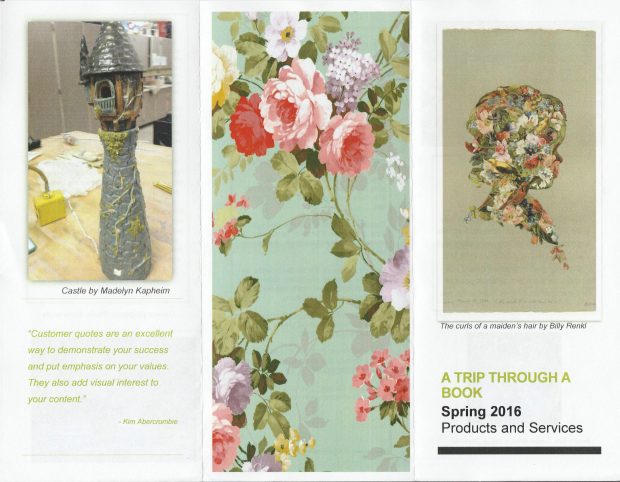
Directions: Create your own exhibition guide for your art show. Exhibition guide should walk your viewers through your art show and provide them with necessary information so they understand your theme/message of the show and layout of your gallery. Students may use Indesign or Publisher to create their 2-3 page guidebook.
IMG_20160421_0003

IMG_20160421_0002

Requirements:

Exhibition guide with likely be a trifold or booklet and must include the following:

Title/Cover Page:

  • Title of your gallery
  • Title of your art show
  • Picture (one attractive piece of artwork that represents the show)

Information about the show:

  • Location (imaginary location-city, state)
  • Run time (imaginary dates-2 weeks, 2 months, other)   
  • Mission statement of show
  • Map of the gallery/digital Homestyler.com model

Information about the art:

  • Artist, Title, Date, Medium of every piece of art in show
  • Small paragraph/blurb about each artist and their piece
  • Selective photos of work (not for every piece but range of work)

Information about your gallery:

  • Who are the curators (that’s you!)
  • Why did you choose to design your gallery the way you did?
  • What future shows would you like to hold in your gallery?

Note: Please use an attractive layout, font, colors and visuals that all work with your art show’s theme and is inviting to the public.

IMG_20160421_0003

IMG_20160421_0002

________________________________________________________________________________

DIY Gallery: Model
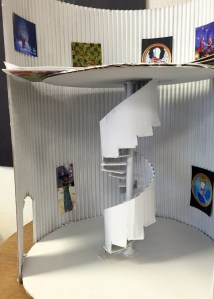
IMG_7709Objective: Design a model of your gallery space that help articulates your gallery’s mission statement and showcases the selected artwork. One model should be completed digitally with http://www.homestyler.com. You will need to create an account with your school email for this site. One model should be 3D and made out of cardboard. Students should paint cardboard white and include a key for the model explaining where artwork will go. Research other art galleries and museums and consider their layout when designing your own. Consider traditional elements of a gallery including blank slate layout (white walls, wood floors, artwork as focal point). Consider sizing of artwork when planning what pieces go where (an instillation piece should have adequate space for viewer to walk around piece, 6ft painting will need larger wall so work has space, etc.)

Requirements:

  • 1 Model should be made digitally with homestyler.com
  • 1 Model should be constructed 3D
    • Made out of cardboard and hot glue
    • Painted white walls
  • Clear simple layout (complements the art)
  • Considerate arrangement of work (pieces thematically tell story)
  • Artwork sizing considered
  • Key/chart:
    • indication where artwork is hung
    • compass/label for bearings
    • title of the gallery
    • mission statement of gallery
    • thumbnail picture of art pieces (8-12)
    • statement explaining gallery design and layout (why pieces go where)

DIY Gallery: Model statement

Explain your thought process is designing the gallery space. Why did you choose this layout? How does the layout relate to your gallery’s mission statement and theme of the art show? What other art galleries/museums did you look at for inspiration for your gallery? What pieces needed extra consideration for placement? (7-9 sentences at least)

________________________________________________________________________________

Design it yourself Gallery: Presentation

Directions: Pitch your gallery idea to Kate Mothes and Ms. Lucas! Presentation should be 15 mins in length and both partners should be actively participating equally. Discuss all components to your gallery including the following: information about the show, art pieces/research process, exhibition guide, layout (digital and scale model), community engagement piece.

Information on show: (3 mins)

  • Title of gallery and exhibition
  • Mission statement
  • Theme of the exhibition
  • Describe artists and their pieces (artist, title, date, medium, meaning)

Research process: (3 mins)

  • Why did you pick the pieces you did?
  • What were some hardships with finding your artists?
  • Why were you drawn to the pieces?
  • What did you learn about your own taste in art through this process?

Exhibition Guide: (3 mins)

  • Why did you design your guide this way?
  • What hardships did you have when creating your guide?

IMG_20160421_0002

IMG_20160421_0003

IMG_20160421_0004

IMG_20160421_0005

Layout of gallery (models): (3 mins)

  • Why did you arrange your model/gallery layout this way?
  • What hardships did you overcome in planning out the location of your pieces or what special considerations did your artwork require?

IMG_7649

Community Engagement: (3 mins)

  • What activity did you provide the public?
  • What are you hoping people take away from participating in activity?
  • How does your activity relate to your theme?
  • Why is it important to have a community engagement piece?

*** Note: This is a formal presentation. Please introduce yourself and conduct yourself professionally in front of our community members. Please rehearse your presentation with your partner in advanced so you meet time and response expectations. Please hold up/display model and guide when describing these pieces. Can provide powerpoint of enlarged images when describing art pieces if desired.

Presentation Feedback (see front of this sheet also):

________________________________________________________________________________

________________________________________________________________________________

________________________________________________________________________________

________________________________________________________________________________

________________________________________________________________________________

Project Feedback (see individual sheets also):

________________________________________________________________________________

________________________________________________________________________________

________________________________________________________________________________

________________________________________________________________________________

________________________________________________________________________________

Unit and images courtesy of the teacher and used with permission. 

Below is the article that was published on April 11, 2016 by The Post Crescent. 

IMG_20160421_0004

IMG_20160421_0003

IMG_20160421_0002

What does a mask say about you?

What does a mask say about you?  Or about the person wearing it?

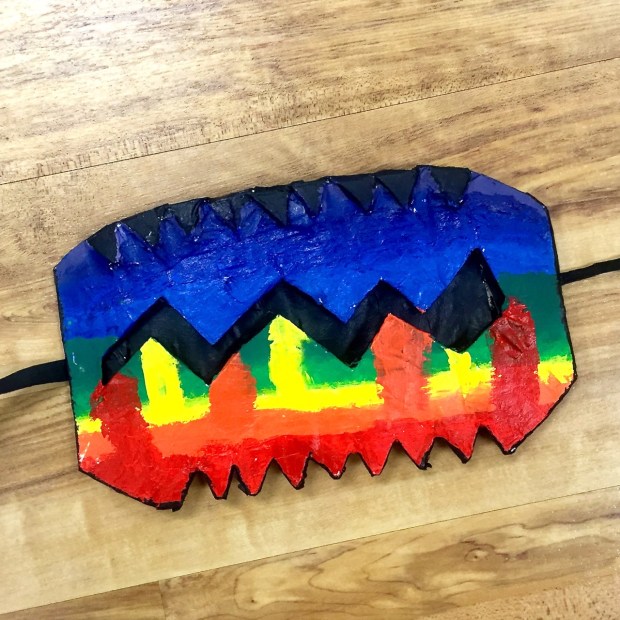
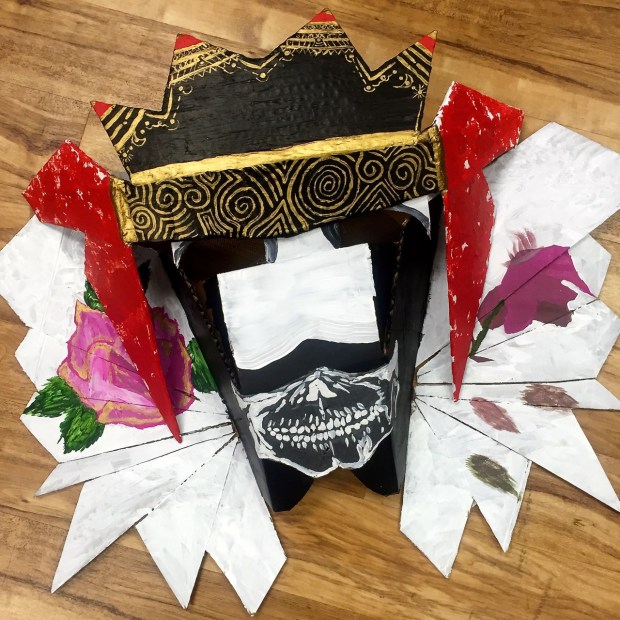
Last quarter 3D Design students designed and created their very own Identity Masks to illustrate whatever they wanted to communicate with the public. Materials used were cardboard, paper mache, gesso, and acrylic paints. Some students’ work were based on their interests while others took a personal approach and took this opportunity to say something about him/herself. 

KAT

K. Luther

My name is Kat, at least that’s what a lot of people know me by. I am a junior and have been to 3 different high schools, I have never really fit in where ever I’ve gone and always kind of felt left out of things. I came to North for a fresh start and I got it. People always wonder what’s behind my mask I put on.

I interpreted what’s behind my facade with this mask. I added some random details that may be weird to some but have meaning to me, like the spikes. The top spikes represent my confusion, mainly done by placement. The color theme is for my over active brain. Purple is my fear. Black is my anger, which on the surface is very hidden, but inside I fight violent urges all the time in my quest to achieve peace.

The black inside of the mouth is how it feels when I try to speak, like I say nothing. I guess my mask represents my hidden pain that I hide.

_________________________________________________________________________________

MARCOS

M.Santillan


My mask doesn’t represent anything all that much. I made it look like a bear, but colored it blue with white markings. The blue color is supposed to represent the calmness of bears, but the white markings represents innocence . I made the mask so I could wear it only on my face, the mask is held in place and fits perfectly which also covers the entire head. There could be be a deeper meaning about the mask and colors used but couldn’t think of a deeper meaning.

_________________________________________________________________________________

KEVIN

IMG_3950

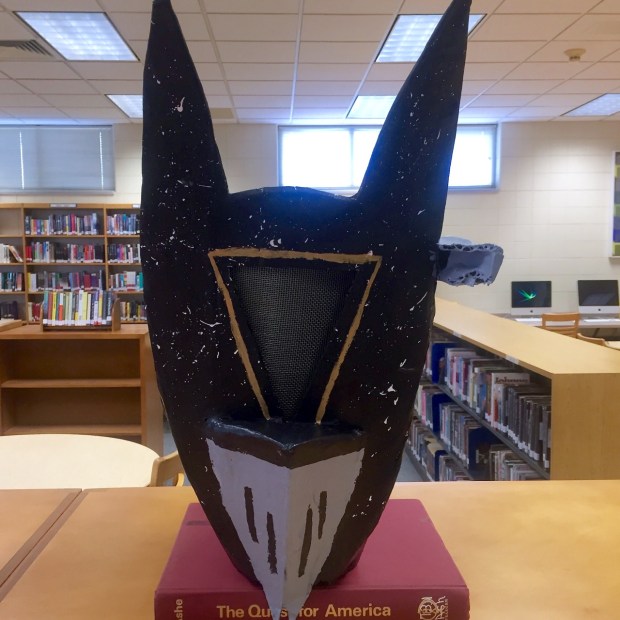
My Character’s  name is Void. He trained with the Spartans and killed his master Raz Al’ Ghul so that he could become the most powerful warrior. He has a brother named Slade. His brother is an Australian soldier that was injected with a cyrum called mirakuru. It gave him strength and power to kill with a single punch. Void was also injected with the same cyrum and had the potential to regenerate quickly. Void is a legit immortal. The brothers had a duel and Void had his brother killed with his own sword right through the eye. Slade was no match for void and his sword.

Another enemy has entered this world of Void and threatened to hunt Void down because rumor has it that he has everlasting life. Rattlehead is the master death. He is capable of taking a mortal’s life and eating its soul by piercing them with his sword through the heart. They began to battle and clashing swords. Void managed to cut his left hand off causing him to lose some of his souls he has taken. At the end we both clashed swords and we both were turned into stones.

To be continued……………

_________________________________________________________________________________

LOGAN

IMG_3946

The mask goes by many names. But all know its true name: Darkness. The mask was once worn by Rattlehead, The master of Death. After thousands of years, the mask became the symbol of destruction and destruction. All that proves that it once truly was real is the replica of it that was found, and of his sword, Soul Reaper.

In the age before machines, all feared dying. Rattlehead enjoyed killing all,, even if they are not to die yet. After thousands of years, he sensed a power of another immortal. He crossed over dimensions to find and slay the power to take as his own. The being was known as Void. A strange being who became immortal. As the two clashed, an explosion erupted and the two vanished from the realm, never to be seen again.

_________________________________________________________________________________     

CHRIS

C. Hartley


_________________________________________________________________________________

FRANK

F.Canseco

_________________________________________________________________________________ 

ADRIANA

IMG_3943